“But let all who take refuge in You be glad; let them ever sing for joy. Spread Your protection over them, that those who love Your name may rejoice in You. For surely, O LORD, you bless the righteous; You surround them with Your favor as with a shield.” Psalm 5:11-12
Today’s post is unplanned. However, we know that those who read these adventures each week are committed to pray and we are grateful.
If you have been following Exploring the Land from the beginning, you will remember our adventures in South Sudan.
Our time among the Nuer People is where our story begins today.
If you need to refresh your memory, click here and it will link you to those stories.
Back in December, we asked you to remember Mathew and his family as war broke out in South Sudan between the Dinka and Nuer people.
Today we are asking you to pray again and continue praying. (We are just now hearing this story).
As the crisis grew and it became evident that they had to flee their home in Leer, Mathew took Sarah and the children to Bentiu to stay in a refugee camp.
Mathew, having a passport, traveled to Nairobi, Kenya, hoping that from here he could procure travel for the others to follow; this was some months ago.
News came to Mathew that the situation in the Bentiu camp was dire with little food, and water and fighting intensifying, Sarah and the children, at that time eight of them, fled farther north. They made it to Khartoum and have been living in a refugee camp there for several months.
Just this past week we understand that one of our missionaries secured tickets on a commercial airline for Sarah and four children. (Evidently, the four older children left the camp trying to make their way to a more secure location).
Sarah and the four children made their way to the airport only to be turned away because they only had travel documents not passports.
There is no way for them to obtain passports from South Sudan.
It seems the way forward, now, is to get them back to South Sudan.
We are hoping they can fly to Juba on a humanitarian flight with their travel documents.
After reaching Juba, they would need to travel by bus to Nairobi, an arduous two day journey.
Don’t you know Sarah and the children are weary – after losing everything and traveling with just the clothes on their back for months? They need to know, with out doubt, that the Lord’s favor is surrounding them as a shield. Mathew needs to have God’s peace that passes all understanding – he is here in safety while his wife and children are struggling.
*Pray specifically that God would unite this family.
*Pray that Sarah and the children would be able to fly to Juba and get a bus to Nairobi.
*Pray that God would spread His protection over them.
*Pray for peace for the country of South Sudan. We knew the window of peace was small – we just didn't think it would close so quickly.
Showing posts with label South Sudan. Show all posts
Merry Christmas
As you consider the great things God has done for you this year, we trust that you will be filled with joy and peace as you celebrate the birth of His Son, our Redeemer.
Today, South Sudan is in the midst of conflict. Please join us in praying for peace. Reports coming out of South Sudan say the conflict is primarily between the Dinka and the Nuer people. We know both Dinka and Nuer and we are very disappointed at this development.
ABC is reporting the uncovering of a mass grave by the UN in Bentiu, the capital of Unity State - 84 miles northwest of Leer where we stayed on our visit to Unity State during our months in South Sudan. They are saying that thousands have died thus far.
South Sudan is in a precarious situation; the infrastructure is little to non-existent, this conflict will have a great residual effect on the many who live a hand to mouth existence.
Do you remember meeting Matthew and his wife, Sarah on our visit to Unity State? They are Nuer and live in Leer, very near the conflict. Please pray God's protection upon them. Pray that Matthew, the young men he is mentoring, and his church will allow the light of God's love and peace to shine through them to those around them in turmoil.
Click here to read the post about Leer and the Nuer people.
We do want to wish you a wonderful Christmas. Share the love of Christ with someone today -- after all He is the reason we celebrate!
Merry Christmas.
Proverbs 19:20 People
“Listen to advice and accept instruction, that you may gain wisdom in the future.” Proverbs 19:20
We have been impressed by some young friends. These apprentice missionaries, living in a local setting, learning a local language, heard the call to go out further.
The place where they will eventually live is deep in the bush of South Sudan. With no cell phone signal, no internet, and no air field; they will be at least two hours out, by road, from neighboring bush missionaries.
The remote area is a 40 minute drive from the nearest small town where only the very basics can be purchased. It is hot and dry in the hot season and hot and wet in the rainy season.
During the rains, the rivers will swell cutting them off, for days at a time, from their town and those friendly missionary neighbors – from medical help if needed – leaving them isolated.
However, they will make friends with those whom they live among, those to whom they minister, those to whom they tell the story of God’s grace.
Spending several hours together today, they asked for advice, trying to glean something from what we experienced and learned during our years on the mission field and our time in South Sudan.
They are Proverbs 19:20 young people, seeking advice and council to gain wisdom for the future. We pray we were helpful.
Willingly, they begin a difficult journey – yet, many times those are the most rewarding.
Ask for God’s blessing to fall upon this young couple; that they would continue the journey understanding that while God’s call isn't easy, He is with them.
Pray that we, and others living in easier situations, would find ways of ministering to those whom God has called to plant their lives in the hard places.
Pray that we all would be Proverbs 19:20 people.
Praying for the People of South Sudan
If you have been able to journey with us through South Sudan
you have already been praying for those who live there.
Thank you.
God continues to lay the people of South Sudan on our hearts
as we compile information, make recommendations and wait for our next research
adventure.
In Colossians 2:2-3, Paul writes;
“My purpose is that they may be encouraged in
heart and united in love, so that they may have the full riches of complete
understanding, in order that they may know the mystery of God, namely, Christ,
in whom are hidden all the treasures of wisdom and knowledge.”
This is our purpose in prayer – That the different peoples
of South Sudan may be
encouraged in heart
united in love
understand the Word of God
know Christ – the mystery of God
united in love
understand the Word of God
know Christ – the mystery of God
Would you join us in praying to this end?
Currently the door of opportunity is open.
Pray that God
would send His workers, who are able to live in hard places, with the message
of the eternal grace and mercy of Christ.
Children are a gift from God. Part 2 School daze!
“Train a child in the way he should go, and when he is old
he will not turn from it.” Proverbs 22:6
School days -- School days -- Little golden rule days.
School is part of life for most children in the U.S. and developed countries around the world. Parents, even governments, realize the importance of reading, writing, and arithmetic.
However for children in most of Africa, school is not a necessary part of life, it is a privilege.
South Sudan is a young nation – not only as a new country; but, over 40% of the population of South Sudan is under 14 years of age – this is an amazing statistic – children make up almost half of the population.
School is part of life for most children in the U.S. and developed countries around the world. Parents, even governments, realize the importance of reading, writing, and arithmetic.However for children in most of Africa, school is not a necessary part of life, it is a privilege.
South Sudan is a young nation – not only as a new country; but, over 40% of the population of South Sudan is under 14 years of age – this is an amazing statistic – children make up almost half of the population.
Children are a gift from God. Part 1 Babies
"Children’s children are a crown to the aged, and parents are
the pride of their children." Proverbs 17:6
Children are a blessing from God – in trying to find this
verse in the Bible, I failed; it may not be there, but it is implied through
many scriptures. This sentiment is revealed
in most cultures and the people groups in South Sudan are no exception.
So, we were surprised our first weeks in South Sudan to
notice women without children on their backs.
We actually discussed this together, “Where are the babies – do they not
carry their babies with them?” We were
astonished that we had not seen South Sudanese women carrying babies on their
backs. We noticed some ex-pat Kenyan or
Ugandan women with babies on their backs, but where were the South Sudanese
babies?
We discovered the answer one morning at church when a woman
walked up carrying a goat-skin carrier under her arm. She put it down on her
lap and lo and behold there was a baby inside!
Imagine our surprise.
Now in our defense, mothers always have a cloth or light
blanket across their shoulder covering the baby as they are walking; so you
really can’t see the baby. The image to
the right shows the way they carry their babies without the blanket covering
and the inset at the top left corner on the picture shows how the carrier holds the baby.
Ingenious – and quite unique, we haven’t seen anything like
it in any other part of Africa.
Not all South Sudanese people groups use this
type of carrier, but the Dinka and the Nuer do.
The Toposa use a goat skin carrier, but they are fashioned so that the
baby is carried on the mother’s back and not under her arm.
Armed with this knowledge, we happened upon another sight
weeks later. While walking through a family
settlement we noticed something hanging from a tree. (See the image at the
left)
The inset image on the bottom left of the picture allows you
see what we saw when we peeked inside.
This newborn is napping quite happily in his goat skin carrier while
gently swaying in the breeze under the shade of their large tree.
Not to be undone – Debbie felt she needed to acquire a baby
carrier – it being so unique and useful, never mind that fact that there will
be no more babies, except possibly grand-babies one day, coming our way.
Since these are not sold in the market, but
are made as needed, we asked a South Sudanese friend if he could procure a baby
carrier for Mama! Grinning, he said he would try, and several weeks later he
brought two baby carriers up to the house.
Here, the lady who made our baby carriers is demonstrating their
use.
Children are a gift from God.
Pray for God’s people to grasp a vision for teaching His
truths to Dinka children that they may grow in the knowledge of God.
The infant mortality rate is high in South Sudan. Good
medical facilities and trained personnel are needed to care for sick and
malnourished children. Vaccinations and medicines are needed to help South
Sudanese children grow healthy and strong.
Pray that God would supply these needs.
These feet were made for walking…and other modes of transport in South Sudan
"Come, O house of Jacob, let us walk in the light of the LORD." Isaiah 2:5
You, who have been part of our journey in South Sudan,
have witnessed the abominable road conditions that are likely to exist. As you would guess, walking is the
most frequently used mode of getting from one place to another; happily walking isn't dependent upon road conditions.
While we were stateside we enjoyed walking for exercise; but that is very different from walking out of the necessity of getting from one place to another. We have witnessed people walking to the hospital; four men, one at each corner of the blanket walking for two days transporting their sick relative/friend to the hospital.
---AND --- as in all of Africa, there is always room for one more. So don’t think you are limited to only one passenger!
Unfortunately the AK47 is also a frequent sight.
Around town these little tuk-tuk vehicles can be seen. With a motorcycle front and a seated trailer behind, they afford a bit of protection from the ever-present dust. They are more comfortable than the back of a motorcycle and can carry more goods safely. However as you may guess, they cost a bit more to hire than your regular motorbike and are operated only in the town centers.
This is a frequent sight, especially on the major transportation route which travels in front of the Baptist compound.
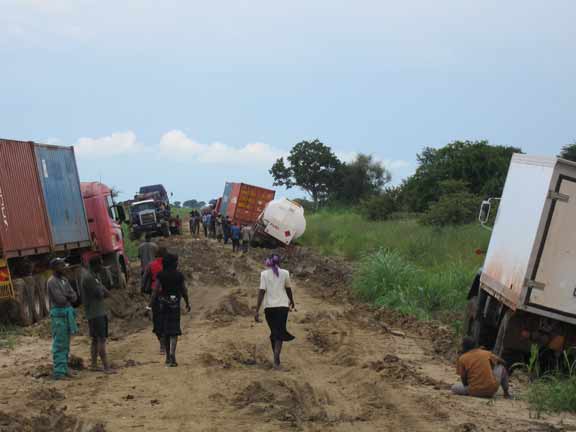
Long distance trucks transporting goods to all parts of South Sudan can take weeks to travel the distance from Uganda or Kenya to their destinations in South Sudan. (Notice the men sitting on top of the load.) Three or four men travel together on one truck to help when the inevitable breakdown occurs.
We often see these trucks on the side of the road, sometimes camping for days if not weeks waiting either for roads to dry, digging out -- in the rainy season -- or waiting for mechanical parts to arrive from town to get the truck running again. It is a dangerous and dusty place to travel.
Pray for safety on the roads. Travel anywhere is a dangerous prospect and South Sudan is no different. Passing or even driving behind a truck in the dry season is very dangerous as the billows of dust make it impossible to see; the possibility of a breakdown in places of unrest or insecurity and the ever present abominable road conditions make traveling in South Sudan an act of faith.
Pray that the people of South Sudan would hear of God's love and believe so they will "walk in the light of the LORD."
You, who have been part of our journey in South Sudan,
have witnessed the abominable road conditions that are likely to exist. As you would guess, walking is the
most frequently used mode of getting from one place to another; happily walking isn't dependent upon road conditions. While we were stateside we enjoyed walking for exercise; but that is very different from walking out of the necessity of getting from one place to another. We have witnessed people walking to the hospital; four men, one at each corner of the blanket walking for two days transporting their sick relative/friend to the hospital.
Folks don’t give a second thought to walking two, four or
even ten miles to town or school – two miles to fetch water is an everyday
occurrence for most women, farther than that and they would most likely try to
use a bicycle.
Next to walking, bicycling is the next most common
mode of transport. Those who have the means of purchasing a bicycle try to do
so. While we often see bicycles carrying
paying passengers or transporting loads of goods; the picture on the right is unique to South
Sudan (at least for us). A good idea for transporting
those too young to “hang on" well – although this little fella looks like he is
pretty good at “hanging on” – a good thing too as his driver seems to be
talking on his cell phone while dodging potholes, animals, cars and people.
Motor bikes are another popular means of movement. While
they preserve your strength, they deplete your wallet; however, in South Sudan,
motorcycles are used as taxis throughout the country. There are very few automotive taxis. Motor bikes can maneuver paths in the bush where cars cannot go.
![]() |
| Awaiting customers |
---AND --- as in all of Africa, there is always room for one more. So don’t think you are limited to only one passenger!
Unfortunately the AK47 is also a frequent sight.
Around town these little tuk-tuk vehicles can be seen. With a motorcycle front and a seated trailer behind, they afford a bit of protection from the ever-present dust. They are more comfortable than the back of a motorcycle and can carry more goods safely. However as you may guess, they cost a bit more to hire than your regular motorbike and are operated only in the town centers.

Here you go!!
This young Dinka man has polio and is unable to walk; however he has a convenient mode of transport which is eco-fuel efficient and can go practically anywhere!
This is a frequent sight, especially on the major transportation route which travels in front of the Baptist compound.
Long distance trucks transporting goods to all parts of South Sudan can take weeks to travel the distance from Uganda or Kenya to their destinations in South Sudan. (Notice the men sitting on top of the load.) Three or four men travel together on one truck to help when the inevitable breakdown occurs.
We often see these trucks on the side of the road, sometimes camping for days if not weeks waiting either for roads to dry, digging out -- in the rainy season -- or waiting for mechanical parts to arrive from town to get the truck running again. It is a dangerous and dusty place to travel.
As you think about the different modes of movement, pray
that the Gospel message would move throughout South Sudan as well, penetrating
hearts and changing lives.
Pray for safety on the roads. Travel anywhere is a dangerous prospect and South Sudan is no different. Passing or even driving behind a truck in the dry season is very dangerous as the billows of dust make it impossible to see; the possibility of a breakdown in places of unrest or insecurity and the ever present abominable road conditions make traveling in South Sudan an act of faith.
Pray that the people of South Sudan would hear of God's love and believe so they will "walk in the light of the LORD."
Journeying forth ...
Journeying forth…
“All the ends of the
earth will remember and turn to the LORD, and all the families of the nations
will bow down before Him, for dominion belongs to the LORD and he rules over
the nations.” Ps 22:27-28
We are on our way out of South Sudan. Our research is finished … which isn’t to say
that we know it all or that all researching of South Sudan is complete. However, we have looked at many places west
of the White Nile and are writing up our recommendations for personnel placement
and ministries.
In the previous post, we talked about the journey to Kapoeta
and meeting the Toposa people. We
secured our vehicle in Kapoeta with the IMB family ministering there and flew
out on an MAF flight (Missionary Aviation Fellowship).
On airstrips like this one, the pilot will buzz the field
before landing to ensure that the goats and cattle scatter away from the
landing area and that the people stand a safe distance away.
As the engine noise dies away and the
propeller stops, people begin to crowd in closer trying to catch a glimpse of
those fortunate enough to come and go on this wonderful mode of transport.
The two pilots, upon exiting the plane, glance over the
structure and proceed to help load our belongings. Many gather around the plane interested in
the activities, the sights and sounds of air travel -- dreaming that one day,
perhaps they would be boarding this small plane and flying to distant places.
After the luggage is secured we gather around in a circle,
and one of the pilots leads in prayer.
HOW COOL IS THAT!!! MAF pilots
are missionary pilots -- flying goods and missionary personnel to remote areas
and sharing God’s love to the ends of the earth. After prayer we board the plane while the
pilots make sure the spectators move back to a safe distance before starting
the single engine propeller craft.
The flight was great – uneventful – which is great.
We are now back home in Nairobi, finishing reports,
cataloguing pictures, writing recommendations and replanting -- for a time --
ourselves in this place. Having seen and
learned much, we still have more to tell; so the blog posts about South Sudan
will continue for several weeks yet.
There is much to do and more prayer is needed for the people of South
Sudan so that --- “All the ends of the earth will remember and turn to the
Lord”
Exploring the South East
“Teach me to do Your will, for You are my God; may Your good Spirit lead me on level ground.” Psalm 143:10.
Things change, the plans of men fail, but God is constant. We see life through a cloud, dimly – without understanding -- as the threads of our lives are woven through the tapestry of the Master’s plan.
We remained in Rumbek longer than we had planned in order to take some visitors to Wau (Wow - this is how we pronounce it), South Sudan’s second largest city. At the last minute, however, they could not come and we made preparations to close up the house in Rumbek and begin our final trip to the southeastern area of South Sudan.
This would be our longest driving adventure. Day one we would head south on the 12 hour trip to Juba (Joo-Bah); day two, driving 9 hours southeast to our destination of Kapoeta (Kah-pwoh-etah).
Stories abound of insecurity, raids by bandits, and shootings on the road which we would travel. A police commissioner was murdered last month as he journeyed down this lonely road on which we now find ourselves. We gratefully acknowledge God's protection and your intercession for safety on our journey.
A shocking sight -- as we crested a small hill, we spotted an abandoned tank -- this would be the first of three tanks spotted before reaching Kapoeta.
Along with visiting this area of South Sudan; we were to deliver our vehicle to a missionary family living outside of Kapoeta, ministering among the Toposa people.
What a wonderful opportunity of fellowship we enjoyed. Privileged to walk with them to an evening Bible study in a nearby village; we witness their dynamic ministry as they pour themselves out to the people of the area in Christ-likeness.
The Toposa are Nilotic people, cattle keepers like the Dinka. We found them to be friendly and hospitable. Toposa women enjoy making and wearing beaded jewelry much like the Maasai in Kenya and Tanzania.

Toposa women remain traditional in their dress unlike the men who have adopted a more western style. Nakedness is often seen as Toposa don’t feel the need to follow the clothing culture adopted during the colonial era.
The skirts Toposa women wear are short (atypical from much of Africa), very full and colorful -- sewing panels of differing fabrics together. The skirt, tied by a string at the waist sits under wide beaded belts. It is quite unique from anything else we have seen in Africa.


As you pray for South Sudan, remember the Toposa people.
Pray they would hear and accept the witness of God’s Word.
Pray the Toposa would seek peace with God and live at peace with their neighbors.
Pray specifically for the Toposa living in and around Kapoeta as this family goes stateside for several months. Pray that those who have accepted the Way, the Truth, and the Life would be faithful to live out and proclaim their witness.
AudiBible
The TWR workshop was beneficial in so many ways. One subject about which we received good
information was the area of digital devices which play audio programs. We knew of the existence of these devices; we
had heard about them several years ago when they first came on the scene. At the time, however, they seemed very
expensive. In addition, they were
programmed from the factory with mostly English programs and they were not
solar powered, so batteries would be needed.
At the workshop we found these devices have improved. Some are now solar powered, they are durable
and easier to use; additionally the repertoire of programs and available
languages for these programs has expanded greatly.
A Great Commission Christian group named ACROSS (African
Committee for Rehabilitation of South Sudan) is producing programs for these
devices and providing the programs in many South Sudanese languages.
Illiteracy is a big issue in South Sudan. Over 70% of South Sudanese are illiterate according to the statistical yearbook. This is especially true among women. Remote areas have difficulty getting radio reception and people have less opportunity to hear the gospel story.
So we bought five of these players and had them programmed
with peace building messages, some literacy training and the New Testament all
in Dinka. (Dinka is the language of the people who live in and around Rumbek.) Concentrating on the message from the audiBible, these women and children are excited to have the Bible read to them in their own language.
We thank God for new technology and the audiBible.
As people hear the Bible spoken in their language, pray that they would learn more about God and His love for them.
Pray that many would come to know Christ, His sacrifice on the cross for their sins, and by faith believe.
Communicating the Gospel across South Sudan
We were privileged to attend a TWR (TransWorld Radio)
workshop in Juba recently. Knowing the
cost of flights from Rumbek to Juba, we opted to drive; even though we knew it
would be a rough trip – as it turned out, it was much harder than we
imagined.
The main route to Juba has been impassible for a week or
so. The all season road washed away
with a portion of it under water.
Another route has temporarily emerged as the
major transit route to Juba from Rumbek – where there’s a will, there’s a way! It
was a rough, but doable, trip in March with the Fusion team.
We hadn’t a clue what this alternate road would bring so we
decided to leave after church on Sunday; we wanted to be there in plenty of
time for the meeting.
Rain began to fall
and darkness was approaching as we entered the small trading center of
Mvolo. (You might remember the name from previous posts, the area where the bridge was out earlier in the year)
The plan was to sleep at the NPA compound where we stayed on a previous trip. No rooms were available however, so we slept in
the car in the safety of their compound. Leaving before dawn the next morning,
we knew that we had a long day ahead of us.
We made it, albeit a couple of hours late for the beginning of the meeting. Traveling from Rumbek to Juba took 7 hours in March; now it takes 12 ½ hours.
Meeting for three and a half days with likeminded Christians, mostly
South Sudanese, who have a heart for sharing the gospel story and discipling
believers across South Sudan and beyond was very uplifting.

Apart from the good information obtained from the meeting,
we enjoyed spending time in fellowship; networking with other Great Commission
Christian groups – hearing stories of the work to the glory of God and
discussing the great task before us as we listed the tremendous needs in South
Sudan.
Thursday afternoon closed our time together and as everyone
left for their home areas, Jerry and I hit the market. We would leave at 5 a.m.
the next morning, attempting to return in one day. But first we would get some
items which have been missing from our diet. Bananas, potatoes, onions and
avocados were on our list. We also found some tomatoes and a cucumber – these
will make a pretty nice salad!
Back in March we hadn’t seen all of the furniture and carpentry;
as South Sudan progresses and Juba grows, it seems more is available and life
may become a bit more comfortable.
The roads were drier as we returned, unfortunately just as
rough; but we made it in 12 ½ hours again, so we were pleased – tired and a bit
stiff, but happy to be back in Rumbek.
We thank God for those who attended the workshop.
Pray that this initiative would grow and out of this small
beginning programs would be developed which would bring people to Christ and
help them grow in their knowledge of God and their love for Him.
Pray that the lines of communication would remain open and
strong between these Christian organizations; that our only purpose would be to
see the people of South Sudan know and love Christ for the glory of God.
The Upper Room
A construction style which we have found unique in South
Sudan, a Sudanese friend dubbed “the upper room”. We have not seen this type of structure anywhere
else in Central, Eastern or Southern Africa. However, as we have not been everywhere yet,
we will not say it is unique to the Dinka of South Sudan, we will just say it
is unique!
Upon inquiry as to why the Dinka would make the effort needed to construct their house in such a way, we were met with a myriad of responses.
Many said for safety and security – from predators, both man
and beast. We have heard hyena at night
at the house and we have been told that leopard frequent our area; with the reports of
cattle raiding and inter-clan violence, we can see the logic of this reasoning.
Others said it was a place to keep smaller
livestock like chickens and goats out of harm’s
way at night and a place for small children to be kept safe and out of mischief.
Still others commented that putting the harvest of
groundnuts and grains like sorghum in the upper room secures it, for a time,
from insects and other pests including the smaller livestock (unless you put
them in there!), which may erode the
year’s harvest .
We just think it is cool!
We’ve seen beds out on the upper platform during the really hot months
of January-April, allowing folks to sleep outdoors in the cooler air -- by bringing
up the ladder one can sleep in relative safety.
While this is not a picture of an upper room, we thought it
an interesting take on the esteem given livestock in South Sudan.
While walking through a small compound the other day, we happened to glance into a hut. Seeing the exalted position this goat seems
to have taken, finding a place of rest at the foot of a bed, was in a way
surprising to our knowledge of African culture in general and yet not so surprising
as we learn more of the Dinka culture.
The Dinka prize their livestock. In other countries it is the owner’s
responsibility to keep his livestock out of the road and away from traffic. Here the driver is responsible if he hits an
animal --whether that animal runs into the road or is lying in the middle of
the road – the driver pays the owner of the beast. So be aware!
Differences in culture make for a unique and colorful world.
As we learn more about the cultures of
South Sudan, we see the beautiful tapestry that God is weaving. Today’s world is an intermingling of
different cultures. However at times culture comes in direct opposition to God’s
word. Pray that God would allow each of
us to be open to other cultures, but in doing so be ready to confront aspects
of culture, especially our own, which conflict with God’s word.
The Life of a Groundnut (aka peanut) in South Sudan
The area in which we live is known for growing groundnuts
(peanuts). The sandy composition of the
soil makes it ideal. There aren’t enough grown for export; but the Dinka grow
them to eat as well as a cash crop, selling them in town to be transported to other towns in
South Sudan where groundnuts are not grown.April, May and even June are planting months.
As the rains began, we witnessed a dramatic increase in activity. The soil is dug either by hand or by oxen. Everywhere you turn folks are out clearing ground and planting seed.
Following planting is a time of waiting. The groundnut is hidden
under the soil and the illustration in James 5:7-8 comes to mind, “Be patient,
then, brothers, until the Lord’s coming. See how the farmer waits for the land
to yield its valuable crop and how patient he is for the autumn and spring
rains. You too, be patient and stand
firm, because the Lord’s coming is near.”
Eventually the groundnut plant appears and begins to flower. Suddenly we again see an increase in
activity as weeding begins. As this is all done by hand, you can imagine the amount of time and effort weeding takes. We are not talking about small gardens here, but large fields. With the older children and adult members of the family actively
involved, it takes on a communal air. The very young children and babies stay at home with a designated older
child.
All the hard work pays off in September, October and
November when the plants are pulled from the ground and the nuts are harvested.
Now reward is reaped from all the previous months of work
and patience.
We were blessed to watch a woman giving the first fruits of
her harvest as an offering to the Lord.
What a joy to witness God’s word alive and active in a person’s life.
This one who, in relation to most of us, has nothing, living in a mud hut with
a dirt floor without the things that we consider essential to life such as;
running water, electricity, sanitation, or furniture. Who typically only owns one
or two changes of clothing; this one gives the first of her harvest to the One
who causes all things to grow!
Oh would that all God’s children be found so faithful and
obedient!
One way to use them is to make maqwanga -- aka peanut butter.
Remember our maqwanga lady from the market? (see Market Re-visited post) Now is the season to make maqwanga at home. This is made by smashing raw peanuts between two stones and rubbing them until they are mostly smooth.
Do you remember the post about our visit to Kulu , (see “Trip to Kulu” post ), when we brought stones back for
Malith and his family was so happy? Well, this is what that was all about.
Those stones are used to grind peanuts to make maqwanga at home. (They also
grow and grind sesame seeds into a paste to use in making sauces and season the
dishes they cook.)
We watched this small friend of ours as she recently enjoyed
the efforts her mother put in making maqwanga for her family.
A bowl of groundnuts also came our way as a generous soul
gave us a gift one Sunday morning.
Well we
shelled them and roasted them with salt over a charcoal fire. They turned out great --a bit labor intensive,
but worth it!
As you pray for South Sudan, pray for a good harvest both physically and spiritually
among the Dinka in South Sudan. A good
physical harvest will help sustain lives; a good spiritual harvest will reap
lives everlasting!
The Market Re-visited
Back in January, we wrote about our first visit to the market. Hopefully this will give you a better feel for these people who we see quite often.
Welcome to our Walmart! Let’s walk down some of the aisles and we’ll
introduce you to some of the people who provide us with the necessities of life
here in Rumbek.
Let us introduce you to Saieth (Sa-ee-th) he is from Kartoumn and is literate in Arabic, but doesn’t
speak English. However we are able to communicate adequately enough to
buy goods from him and to call him friend.
Today we are purchasing beans – chili’s a’comin’ !
Notice the scale. Everyone uses this type of scale with weights
measuring from 500gram – 2 kilogram.
Meet our maqwanga lady. (Ma-kwa-ngah) means peanut butter! When we first arrived we went to the market looking for peanut butter and no one had any – can you imagine? We knew ground nuts (peanuts) were a major crop of the area and couldn’t imagine that they would not have it.
Well – we didn’t know what to ask for – you see peanut butter is
imported and in truth there wasn’t any available. Joe, a young man who came out
with the Fusion team had been here
before; he let us in on the secret --
ask for maqwanga. We went the
very next day and this lady has been one of our Sudanese friends ever since.
This product is pure peanuts, no added sugar, salt or preservatives. …mmmm delicious!
She is
very accomodating; if you don’t bring your own container she will put your maqwanga
in a used/empty soft drink can which has been cut in half. ( You can see the
cans in the picture) She fills the bottom with maqwanga and sticks the top half
of the can inside for the lid. She is
also diversified in her sales approach, not only does she sell maqwanga but she
also sells dried fish, (bottom right corner).
Here is one of the many boys
from whom we buy our “Dinka” bread. We
glance at each boy’s offering as we walk by looking for the thickest ones. Debbie came to S.Sudan ready to bake our
bread, but after one piece of Dinka bread we decided there was no need – this
stuff’s great! ...slap on some maqwanga
and you’ve got lunch!
… steak anyone?
These men will sell any piece off of a cow that you want, from
the head to the hoof, including small and large intestines or stomach! Don’t ask for a T-bone or a rump steak
however, their vocabulary doesn’t extend to specific cuts; just point at the
piece you think looks good.

If you can’t find a piece to suit you, the guy with the hatchet at the wooden stump will hack off what you want, bones and all. Come early in the day for the best selection and the least amount of fly larvae.
We have bought meat here, but not often. It takes quite a bit of work to wash off all
the bone chips and cut away the gristle from the meat; so we are more likely to
use the soy meat substitute we brought with us or go vegetarian. However, the meat we have cooked from the market is very tasty. It has a rich almost wild flavor.
We thank God for the people we are meeting in Rumbek. Greeting us with a friendly grin and a warm handshake; they seem genuinely happy that we are here. Join us in praying that we would demonstrate and share the love of Christ with those we encounter.
Exploring Unity State - part 5
Wrapping up - Homeward Bound
We had a great visit to Leer, but now it is time to head home. It has rained this week, Wednesday night we had a terrific storm, so we are uncertain as to road conditions, but this is the middle of the rains and if we don't try we may be here a VERY long time.
Friday we loaded the car for the trip back. Since the sun was out in full force, we waited until the afternoon before leaving allowing time for the mud on the roads to dry as much as possible.
While we waited, this young man decided to be creative -- surrounded by all the "play dough" he needed, he decided to make good use of it by building a mud motorcycle.
He would be going with us along with his mother, his younger sister and brother and his brand new baby brother. His mother is Mathew's sister-in-law.
They live "in the bush" around an even smaller town called Mayendit (Mah-yen-DEET). Her husband sent them, to Mathew's house several weeks ago to have the baby in town.
Mathew's house has three rooms, each the size of a small bedroom in the U.S. Mathew and his family stayed in one room, his sister-in-law and her children were in another, and Jerry and I had the remaining room. All other aspects of life is lived outside.
Piling into the car, we said our goodbyes and were off; however it was to be a short journey. Do you remember the place we were stuck overnight in the mud outside Leer? Well, that was our demise. We tried the top of the road this time but the ruts were too deep and the mire sucked us back down. We couldn't get out. We were only there a couple of hours before being towed out by a bus coming from Leer to drop people off. Once out, we return to Leer and Mathew's house for the night, it is too late to go on -- we will try again tomorrow.
Saturday morning, realizing we will need all the daylight we can get, we decide to leave early. Making it through the first mud pit (our nemesis) – it feels rather like the greatest race or something; you know there are obstacles, but you don’t know what they are or how many. So we move forward by faith, knowing that whatever happens, God is in control of our lives and circumstances. (Only we really would like to sleep in our own bed tonight!) We know people are praying for us – we texted prayer requests to folks in Kenya and we know they are praying!
At
one juncture it looked pretty grim. Just
as we decide we must turn back, along comes God’s answer.
Two UN vehicles push by us only to get stuck in the muck ahead -- the same muck we were hesitant to go through. These guys have a couple of things we do not have. They are two vehicles traveling together. One takes point, making the other available to tow it out and they have a Nuer/English speaker with them so they can inquire about conditions ahead. Mathew’s sister-in-law doesn’t know English. So Jerry asked them if we could travel with them. We would have to keep up, but they agreed. (They didn’t know it, but they were an answer to prayer.) Following these two vehicles we were better able to navigate through the mire as we watched their vehicles skid and slide around.
Dropping off our passengers, we bid them farewell and push on, not wanting to fall too far behind our convoy.
After leaving Unity State we were forced to watch as our convoy drove off. Our car was overheating. Now what! We sat by the side of the road waiting for it to cool down.
Long story short – God is victorious and allows us to be as well.
After spending several hours on this desolate part of the road praying for God to fix the car; trying everything we knew and had with us, water, oil, cleaning the air filter -- every time we pulled out we could only go a couple of kilometers before overheating again.
Finally we saw God’s hand. We had let the engine cool down for an hour or more, night was fast approaching and envisioning a night in the car, we prayed for God’s protection, provision, and wisdom. This area is very insecure, there is no cell phone signal and we had seen many people with AK47s on the road earlier.
We had already put water in the radiator and the overflow, but the Lord led
Jerry to put in even more and finishing up all the water we had with us, we started
again. Almost immediately the needle headed for H (Hot) – then a miraculous thing
happened – as we watched the temperature needle on H it began to go down, just
like a finger was forcing it downward – looking at each other in delighted amazement,
we are convinced we saw the finger of God!
Continuing on, Jerry gradually speeds up and before you know it we are traveling at a good clip heading for Rumbek. The return trip of 13 hours was exhausting, (a regular five hour trip); but you never saw two happier people when we pulled into our gate in the pouring rain.
Thank you for praying for us. We know you do because we see God’s hand at work in our lives every single day. When you pray for us you partner with us, helping to spread the Gospel to the ends of the earth.
We had a great visit to Leer, but now it is time to head home. It has rained this week, Wednesday night we had a terrific storm, so we are uncertain as to road conditions, but this is the middle of the rains and if we don't try we may be here a VERY long time.
Friday we loaded the car for the trip back. Since the sun was out in full force, we waited until the afternoon before leaving allowing time for the mud on the roads to dry as much as possible.While we waited, this young man decided to be creative -- surrounded by all the "play dough" he needed, he decided to make good use of it by building a mud motorcycle.
He would be going with us along with his mother, his younger sister and brother and his brand new baby brother. His mother is Mathew's sister-in-law.
They live "in the bush" around an even smaller town called Mayendit (Mah-yen-DEET). Her husband sent them, to Mathew's house several weeks ago to have the baby in town.
Mathew's house has three rooms, each the size of a small bedroom in the U.S. Mathew and his family stayed in one room, his sister-in-law and her children were in another, and Jerry and I had the remaining room. All other aspects of life is lived outside.
Piling into the car, we said our goodbyes and were off; however it was to be a short journey. Do you remember the place we were stuck overnight in the mud outside Leer? Well, that was our demise. We tried the top of the road this time but the ruts were too deep and the mire sucked us back down. We couldn't get out. We were only there a couple of hours before being towed out by a bus coming from Leer to drop people off. Once out, we return to Leer and Mathew's house for the night, it is too late to go on -- we will try again tomorrow.
Saturday morning, realizing we will need all the daylight we can get, we decide to leave early. Making it through the first mud pit (our nemesis) – it feels rather like the greatest race or something; you know there are obstacles, but you don’t know what they are or how many. So we move forward by faith, knowing that whatever happens, God is in control of our lives and circumstances. (Only we really would like to sleep in our own bed tonight!) We know people are praying for us – we texted prayer requests to folks in Kenya and we know they are praying!
At
one juncture it looked pretty grim. Just
as we decide we must turn back, along comes God’s answer. Two UN vehicles push by us only to get stuck in the muck ahead -- the same muck we were hesitant to go through. These guys have a couple of things we do not have. They are two vehicles traveling together. One takes point, making the other available to tow it out and they have a Nuer/English speaker with them so they can inquire about conditions ahead. Mathew’s sister-in-law doesn’t know English. So Jerry asked them if we could travel with them. We would have to keep up, but they agreed. (They didn’t know it, but they were an answer to prayer.) Following these two vehicles we were better able to navigate through the mire as we watched their vehicles skid and slide around.
Dropping off our passengers, we bid them farewell and push on, not wanting to fall too far behind our convoy.
After leaving Unity State we were forced to watch as our convoy drove off. Our car was overheating. Now what! We sat by the side of the road waiting for it to cool down.
Long story short – God is victorious and allows us to be as well.
After spending several hours on this desolate part of the road praying for God to fix the car; trying everything we knew and had with us, water, oil, cleaning the air filter -- every time we pulled out we could only go a couple of kilometers before overheating again.
Finally we saw God’s hand. We had let the engine cool down for an hour or more, night was fast approaching and envisioning a night in the car, we prayed for God’s protection, provision, and wisdom. This area is very insecure, there is no cell phone signal and we had seen many people with AK47s on the road earlier.
Continuing on, Jerry gradually speeds up and before you know it we are traveling at a good clip heading for Rumbek. The return trip of 13 hours was exhausting, (a regular five hour trip); but you never saw two happier people when we pulled into our gate in the pouring rain.
Thank you for praying for us. We know you do because we see God’s hand at work in our lives every single day. When you pray for us you partner with us, helping to spread the Gospel to the ends of the earth.
Subscribe to:
Posts (Atom)